Fleet Insurance Explained: Coverage for Trucking Businesses
- Guyorguy Laguerre
- Apr 25
- 8 min read


Many fleet operators discover their standard commercial auto policy has dangerous gaps only after a major accident or cargo loss. That assumption costs trucking businesses millions every year. Whether you run five trucks or fifty, fleet insurance is the specialized layer of protection that keeps your operation solvent when things go wrong. This guide breaks down exactly what fleet insurance covers, how modern policies work in 2026, what drives your premiums, and the practical steps you need to take to protect your business the right way.
Table of Contents
Key Takeaways
Point | Details |
Fleet insurance scope | Fleet insurance covers multiple commercial vehicles under one streamlined policy for broad protection. |
Key risks protected | It shields your fleet against major risks like accidents, theft, and cargo loss. |
Modern telematics | Telematics solutions can lower premiums and improve safety by enabling real-time tracking and data-driven pricing. |
Optimize coverage | Shop, compare, and review fleet policies regularly to align with your business growth and evolving risks. |
What is fleet insurance and how does it work?
Fleet insurance is not simply a bulk discount on individual auto policies. It is a purpose-built commercial product designed around the reality that trucking businesses operate multiple vehicles, multiple drivers, and significant cargo liability simultaneously. Fleet insurance provides umbrella coverage for multiple vehicles under a single policy, tailored for businesses with commercial vehicles. That single-policy structure is the core advantage: one renewal date, one insurer relationship, and one claims point of contact.
For trucking companies specifically, fleet policies can cover a wide mix of vehicle types, from long-haul semi-trucks to box vans and specialty equipment. A commercial truck insurance basics framework typically layers primary liability, physical damage, uninsured motorist protection, and optional cargo coverage into one consolidated package. Compare that to managing six separate individual policies across six different renewal cycles, and the operational advantage becomes clear.
Here is a direct comparison of how the two structures differ:
Feature | Fleet Insurance Policy | Individual Commercial Auto |
Number of vehicles | 3 or more under one policy | One vehicle per policy |
Renewal management | Single renewal date | Multiple renewal dates |
Driver flexibility | Any listed driver on any vehicle | Driver locked to specific vehicle |
Pricing structure | Volume-based, risk-pooled | Per-vehicle individual pricing |
Add-on options | Cargo, liability, non-trucking use | Limited to vehicle-specific add-ons |
Claims management | Centralized | Separate claims per policy |
For operators exploring truck insurance quotes, fleet policies often deliver better per-unit pricing once you cross the eligibility threshold. Most insurers set that threshold between three and five vehicles. Beyond vehicle count, typical eligibility requirements include:
A minimum fleet size of 3 to 5 commercial vehicles
A valid USDOT or MC number for interstate carriers
A documented driver roster with motor vehicle records (MVRs)
A claims history report covering the past three to five years
Proof of vehicle ownership or lease agreements
For a deeper look at how freight insurance structures compare internationally, the requirements above align closely with standard carrier credentialing practices across North America.
Key risks covered by fleet insurance
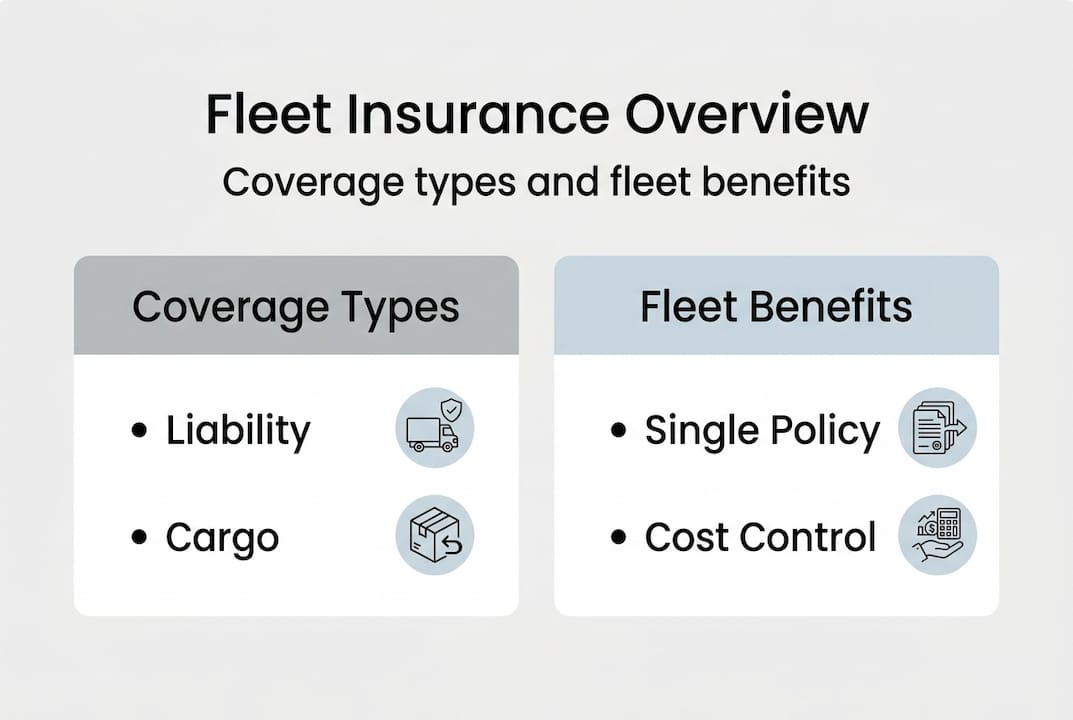
Fleet insurance is not just about collision coverage. It is a risk-management instrument built to address the layered exposures that come with running a commercial trucking operation. Fleet insurance covers risks like collisions, theft, cargo loss, and non-trucking liability, which maps directly to the real-world events that put trucking companies out of business.
Here is a breakdown of the core risk categories and what they mean in practice:
Third-party liability: Covers bodily injury or property damage your trucks cause to others. This is legally required and typically the largest coverage limit in any fleet policy.
Physical damage (own-damage): Pays to repair or replace your vehicles after accidents, regardless of fault.
Cargo loss and damage: Covers freight in transit that is lost, stolen, or damaged. This is often an add-on but critical for carriers hauling high-value loads.
Non-trucking liability (bobtail): Protects drivers operating their truck outside of active dispatch, a gap that standard liability policies do not fill.
Theft and vandalism: Covers stolen vehicles, stolen cargo, and deliberate damage to equipment.
Weather-related damage: Hail, flooding, and wind events that damage trucks parked or in transit.
Understanding the costs and risk factors behind your specific exposure is essential when selecting coverage limits.
But knowing what IS covered matters less if you do not know what is excluded. Most standard fleet policies will not cover:
Damage resulting from deliberate driver misconduct or illegal activity
Mechanical breakdown or maintenance failures
Cargo spoilage due to improper loading (often excluded unless a specific endorsement is added)
Claims involving unlisted or unverified drivers
A refrigerated carrier in Texas lost a $180,000 produce shipment when a driver ran a red light during an unauthorized detour. The claim was partially denied because the route deviation violated policy terms. That single incident cost more than two years of premium payments.
This example from real-world freight insurance essentials illustrates exactly why reading your policy exclusions is not optional. It is operational survival.
Modern innovations: How telematics and data-driven underwriting change fleet insurance
The most important shift in commercial fleet insurance over the past decade is not a new coverage category. It is the way insurers now price risk. Telematics has changed everything.
Telematics systems use GPS-enabled devices installed in each vehicle to collect real-time data: speed, braking patterns, acceleration, idle time, route adherence, and hours of service. That data feeds directly into underwriting models. The result is that two fleets of identical size and cargo type can pay radically different premiums based purely on demonstrated driver behavior.

Telematics-enabled fleet insurance rewards safe driving with rebates up to 10%, making pricing more dynamic and personalized. For a fleet spending $200,000 annually on insurance, that is a $20,000 swing based on data you already have access to.
Here is how the traditional model compares to telematics-driven underwriting:
Factor | Traditional Static Model | Telematics-Driven Model |
Pricing basis | Historical claims, vehicle type, cargo class | Real-time driver behavior data |
Discounts | Locked in at renewal | Dynamic, earned throughout policy period |
Claims prediction | Backward-looking averages | Predictive risk scoring |
Driver accountability | Limited visibility | Per-driver scoring and reporting |
Premium adjustments | Annual only | Quarterly or continuous |
For operators who have explored bobtail insurance and telematics options, the connection between behavior data and coverage pricing is already familiar. Implementing telematics for insurance purposes requires:
Installing approved GPS telematics devices across all fleet vehicles
Sharing data with your insurer through an approved portal or API connection
Setting internal benchmarks so you can coach drivers before data negatively affects premiums
Reviewing monthly telematics reports and addressing high-risk behavior patterns proactively
Pro Tip: Do not wait for your insurer to flag problem drivers. Pull your telematics data monthly, identify the bottom 10% of performers by safety score, and run targeted coaching sessions. Proactive risk management like this can protect your discount tier at renewal.
Steps to secure and optimize your fleet insurance policy
Effective fleet insurance involves evaluating your risk profile, shopping policies, and adjusting coverage as operations change. Here is how to do that methodically:
Assess your risk profile first. Catalog every vehicle, its use case, typical cargo value, and operating territory. Know your MVR data before your insurer pulls it.
Gather the right documents. You need vehicle titles or lease agreements, driver rosters with license numbers, MVRs for all drivers, prior claims history (3 to 5 years), and your USDOT number.
Compare at least three quotes. Use brokers who specialize in commercial trucking, not general business insurance. Niche expertise matters when the policy language gets specific.
Check coverage features, not just price. Compare liability limits, cargo sublimits, deductible structures, and whether telematics discounts are available.
Review every exclusion carefully. Pay special attention to driver exclusion clauses, cargo type restrictions, and route limitations.
Bind the policy and implement telematics immediately. Do not wait until renewal to start building your safety data record.
Schedule a 6-month mid-term review. Confirm coverage still matches your actual operations, especially if you have added vehicles or new cargo types.
For additional guidance on insurance conditions for fleets, aligning your policy terms with carrier contract requirements is a step many operators skip until a claim is denied.
Pro Tip: At renewal, bring your claims history summary AND your telematics safety report to the negotiation. Insurers respond to data. A documented 12-month improvement in driver safety scores is leverage, and most operators never use it.
Common mistakes to avoid: underestimating driver risk by skipping MVR checks, failing to report fleet additions mid-term, and assuming your cargo coverage automatically matches shipper contract requirements.
A fresh perspective: Why traditional fleet insurance leaves value on the table
Here is something most brokers will not tell you: the standard fleet policy is engineered around average risk, not your risk. It is priced on industry loss ratios, not your actual operational discipline. That means safety-focused fleet operators consistently subsidize the claims of less-disciplined competitors.
Most fleet policies lag behind industry risk-management best practices. Telematics data and real-time risk reporting are sitting unused in dashboards that nobody reviews. That is a missed opportunity worth real money. The motor carrier coverage insights we share consistently show that operators who actively manage their telematics data earn better terms than those who set and forget.
Beyond price, customized coverage and claims service quality are where true policy value lives. A policy that pays 15% less at renewal but takes 60 days longer to settle a major cargo claim is not a good deal. When reviewing your options for reducing trucking insurance cost, factor in claims response time, adjuster availability, and specialized trucking expertise, not just the premium line on page one.
Get comprehensive coverage for your fleet today
You now have the framework to evaluate, secure, and optimize fleet insurance that actually matches how your operation runs. The next step is connecting with specialists who understand the trucking industry from the inside out, not generalist brokers filling out a form.
At Insuaria, we work exclusively with fleet operators and logistics businesses to build tailored coverage that reflects your actual risk profile, not a template. Whether you are looking to review an existing policy or start your fleet insurance inquiry from scratch, our team delivers no-obligation consultations designed around your fleet size, cargo type, and operational footprint. Operational certainty starts with the right policy.
Frequently asked questions
How many vehicles do I need to qualify for fleet insurance?
Typical fleet eligibility starts at 3 to 5 commercial vehicles, though some specialized insurers may accommodate smaller fleets with unique risk profiles.
Does fleet insurance cover cargo losses and damages?
Cargo losses can be covered by fleet insurance policies when cargo coverage is added as an endorsement, protecting freight in transit against loss, theft, or physical damage.
Can using telematics reduce my fleet insurance premium?
Yes. Telematics can earn up to 10% in premium rebates when safe driving data is consistently documented and shared with your insurer.
What is not covered by most fleet insurance policies?
Most policies exclude intentional damage, illegal vehicle use, claims involving unlisted drivers, and losses caused by deferred maintenance or mechanical neglect.
How often should I review or update my fleet insurance policy?
Policy review is recommended annually at minimum, and immediately whenever your fleet expands, your cargo types change, or new regulatory requirements affect your operations.
Recommended
Comments