Commercial Auto Insurance Explained: Secure Your Fleet Assets
- Guyorguy Laguerre
- Apr 26
- 8 min read


Running a truck fleet without the right commercial auto insurance is like hauling a full load with bald tires. The risk is invisible until everything goes wrong. Regulatory penalties from the FMCSA can shut down operations overnight, and a single at-fault accident without adequate liability coverage can wipe out years of profit. Many fleet operators assume their existing coverage is enough, only to discover critical gaps during a claim. This guide breaks down exactly what commercial auto insurance covers, what the law requires, what your fleet will realistically pay in 2026, and how to build a coverage strategy that actually holds up under pressure.
Table of Contents
Key Takeaways
Point | Details |
Regulatory compliance matters | FMCSA sets strict minimum liability requirements, and proper filings are essential for fleet legal operation. |
Costs are highly variable | Fleet insurance rates range widely and are driven by authority age, records, cargo, and operational radius. |
Coverage gaps risk assets | Failing to align insurance to fleet specs and regulatory needs exposes carriers to losses and penalties. |
Strategic reviews lower costs | Annual coverage audits and self-insured deductibles help minimize premiums without sacrificing protection. |
Understanding commercial auto insurance for fleets
Commercial auto insurance is a policy specifically designed to cover vehicles used for business purposes, including semi-trucks, flatbeds, tankers, and the cargo they carry. Unlike personal auto policies, which only cover private, non-commercial use, commercial coverage is built to handle the scale, liability exposure, and regulatory complexity that comes with operating trucks professionally.
For fleet operators, commercial truck insurance basics generally include several layered protections:
Primary liability: Covers bodily injury and property damage you cause to others
Physical damage: Pays for repairs or replacement of your own trucks (collision and comprehensive)
Motor truck cargo: Covers freight in transit against loss, theft, or damage
Uninsured/underinsured motorist: Protects your drivers when the other party lacks sufficient coverage
Specialized endorsements: Non-trucking liability, trailer interchange, bobtail coverage, and more
The regulatory layer is where most fleet operators get caught off guard. The Federal Motor Carrier Safety Administration (FMCSA) sets mandatory minimum liability coverage levels that every carrier operating in interstate commerce must maintain. Specifically, minimum liability requirements set $750,000 for general freight, $1 million for oil and hazardous materials, and up to $5 million for certain hazardous materials shipments. Beyond the dollar amounts, carriers must also file forms like the MCS-90 endorsement and the BMC-91 bond to prove coverage and maintain operating authority.
Personal auto insurance simply does not fulfill these requirements. Carriers who attempt to use personal policies for commercial operations face claim denials, license revocation, and FMCSA fines. Liability coverage for trucking fleets must be structured specifically around commercial use, cargo type, and operational radius.
Pro Tip: Always verify that your policy explicitly names your operating authority number. Missing this detail has caused carriers to lose their authority even with active coverage in place.
Understanding the basics is the foundation. The next section unpacks how each coverage type directly connects to protecting real assets on the road.
Core coverage types and how they protect your assets
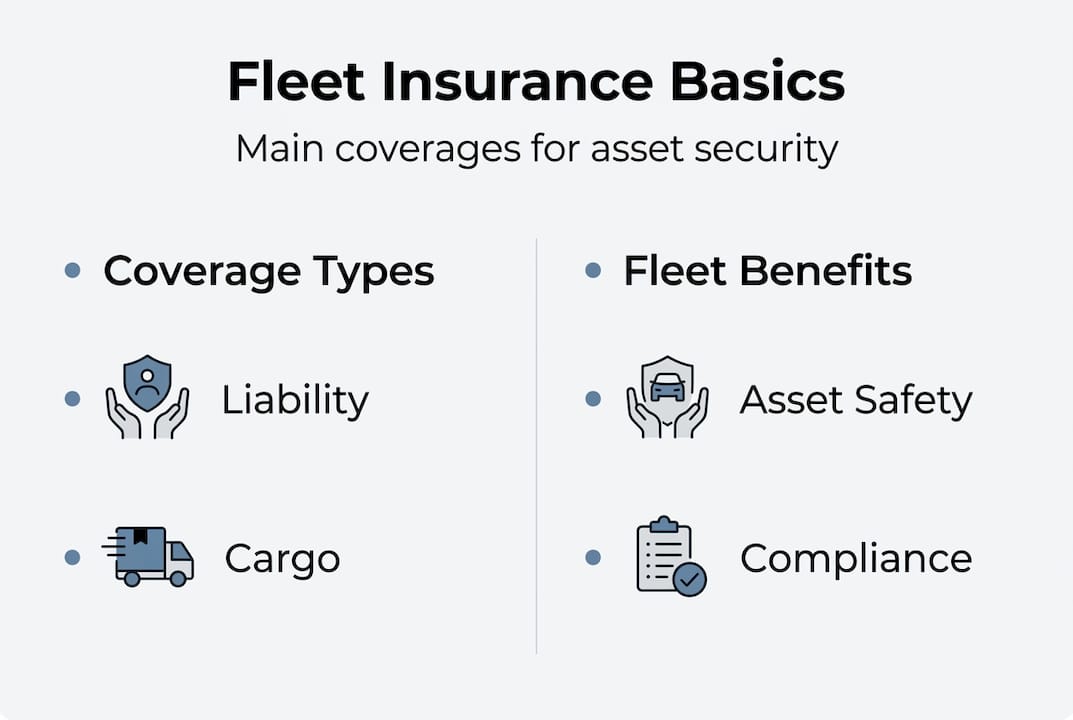
Fleet operators who think of insurance as a single product are setting themselves up for gaps. Commercial trucking insurance is a stack of coverages, and each layer serves a distinct purpose.
Coverage type | What it protects | Who needs it |
Primary liability | Third-party injuries and property damage | All carriers (mandatory) |
Physical damage | Your trucks (collision and comprehensive) | Financed or high-value fleets |
Motor truck cargo | Freight in transit | Carriers hauling goods |
Uninsured motorist | Your drivers hit by uninsured parties | All fleets |
Non-trucking liability | Off-duty personal use of trucks | Owner-operators leased to carriers |
Here is how each one plays out in the real world:
Primary liability absorbs the largest potential losses. A single accident involving a 40-ton truck and multiple vehicles can generate claims well into the millions. Policies meeting FMCSA minimums starting at $750,000 for general freight are the legal floor, not a suggested level.
Physical damage protects the asset itself. A totaled Class 8 truck costs $150,000 or more to replace. Without this coverage, one catastrophic accident puts your equipment investment at zero.
Motor truck cargo covers what you are paid to protect. Review cargo insurance basics to understand exclusions like temperature-sensitive freight or electronics, which often require endorsements.
Uninsured motorist fills a gap that catches many fleets off guard. About 13% of U.S. drivers are uninsured, meaning the odds of your driver getting hit by one over a million-mile fleet operation are not trivial.
Endorsements such as trailer interchange and bobtail are often overlooked. These cover equipment you do not own and trucks being driven without a loaded trailer, both common scenarios in active fleet operations.
“Most fleet losses that go uncovered are not from missing the main policy. They come from not buying the right endorsements for the specific operations being run.”
The motor carrier insurance guide outlines how to match endorsements to your specific fleet profile. Following insurance tips for trucking companies can help you avoid the most common coverage gaps before they become expensive surprises.
Commercial auto insurance costs: What fleets really pay
Premiums are one of the most misunderstood parts of running a trucking business. Many operators benchmark their cost against a neighbor’s experience without accounting for the variables that make every fleet’s rate unique.

Fleet size | Estimated annual premium | Key cost drivers |
Owner-operator (1 truck) | $8,000 to $14,000 | MVR, cargo type, radius |
Small fleet (2 to 5 trucks) | $15,000 to $40,000 | Authority age, driver pool |
Medium fleet (6 to 20 trucks) | $40,000 to $120,000+ | Loss history, safety programs |
According to industry cost data, owner-operators pay between $8,000 and $14,000 per year, while small fleets of 2 to 5 trucks typically see $15,000 to $40,000 annually. New authorities pay a steep premium, often 40 to 100% more than established carriers, simply because underwriters lack loss history to assess their risk.
The main factors that drive your number up or down:
Authority age: New MC numbers are seen as high risk by underwriters
Motor vehicle records (MVR): Violations and accidents on driver records increase costs significantly
Cargo type: Hazardous materials, refrigerated goods, and electronics all carry higher premium categories
Operating radius: Local hauls are cheaper to insure than long-haul interstate routes
Loss history: A clean claims record is one of the fastest paths to lower premiums at renewal
Vehicle age and value: Newer equipment with telematics can lower physical damage rates
Understanding these levers gives you real control. Strategies that reduce trucking insurance costs include investing in driver safety programs, installing ELD and dashcam systems, and maintaining consistent MVR monitoring across your whole fleet.
Pro Tip: Get your underwriting submission in order before shopping quotes. Clean MVRs, detailed vehicle lists, and a documented safety program can mean the difference between a standard rate and a preferred one.
For broader context on operating cost control, reducing shipping costs ties directly into how premium savings compound with other logistics efficiencies. The combination of tighter margins and rising premiums makes cost awareness a core part of fleet management today.
Expert strategies: Maximizing protection and minimizing risk
Knowing what coverage costs is one thing. Knowing how to get more protection for that spend is where experienced fleet managers pull ahead.
Here are the most effective strategies used by operators who have figured out how to build solid coverage without overpaying:
Verify GVWR and operational radius in underwriting. If your policy lists a 100-mile radius and your drivers regularly run 300 miles out, you have a gap. Real 2026 cost analysis confirms that mismatches in GVWR and radius specifications are among the most common underwriting errors that lead to denied claims.
Use self-insured deductibles strategically. Fleets with 10 or more units can often take on higher deductibles in exchange for lower premiums. The savings go into a reserve fund to cover minor claims internally, keeping premiums down while maintaining strong outer coverage.
Audit your coverage annually. Your fleet changes, your cargo mix changes, and your drivers change. An annual review with your broker is not optional, it is essential. Factors behind high premiums often trace back to outdated policy terms that no longer match the current operation.
Implement a formal driver qualification file (DQF) system. Underwriters reward carriers who demonstrate rigorous hiring and monitoring standards. A documented DQF process shows that you are actively managing the biggest risk variable: human behavior behind the wheel.
Review endorsements against actual operations every cycle. Fleets that add a new cargo type or begin intermodal operations mid-year often forget to update their endorsements. One uncovered load can cost more than years of endorsement premiums.
For fleets ready to build a smarter coverage structure, guidance on getting the best truck insurance quotes walks through the submission process in detail.
Linking smart underwriting to broader shipping risk mitigation strategies gives fleet operators a full picture of how insurance fits into a broader operational risk framework.
Why most fleets misunderstand risk and what actually works
Here is a perspective that might surprise you: most fleet operators who overpay for insurance or end up underinsured are not making financial mistakes. They are making a conceptual mistake. They think of risk as the chance of an accident. But for commercial trucking, regulatory risk is often bigger than physical risk.
A carrier can go years without a crash and still face fines, authority suspension, or forced shutdown because their MCS-90 filing was incorrect or their cargo endorsement did not match their actual haul type. That kind of compliance failure does not show up in an accident statistic. It shows up in a federal audit.
The fleets that manage this well do not necessarily have lower accident rates. They have better systems. They verify every underwriting detail, they review coverage at least once a year, and they treat high premium cost factors as diagnostic signals rather than fixed costs.
The 2026 cost analysis for new fleets makes clear that new authorities pay a premium tax, and the only way to reduce it is through demonstrated compliance and loss-free operation over time. Shortcuts do not exist here. But clarity and consistency do work.
Get tailored solutions for your fleet’s insurance needs
You now have a clear picture of what commercial auto insurance requires, what it costs, and where most fleets leave themselves exposed. The next step is connecting with specialists who understand the trucking industry at the detail level your operation demands.
At Insuaria, we work directly with fleet operators and logistics managers to build coverage programs matched to your actual haul types, authority age, and driver profiles. Whether you are managing five trucks or fifty, our team helps you avoid the regulatory blind spots that standard brokers miss. Submit your fleet details through our fleet insurance inquiry services and get a coverage assessment designed around your real operational needs, not a generic template.
Frequently asked questions
What is commercial auto insurance and why isn’t personal coverage enough for fleets?
Commercial auto insurance covers trucks for business risks and regulatory requirements, including FMCSA-mandated liability minimums and filings like MCS-90 and BMC-91 that personal policies cannot fulfill.
How much does commercial auto insurance cost for a small fleet?
Small fleets of 2 to 5 trucks typically pay between $15,000 and $40,000 annually, with costs shaped by driving records, cargo type, authority age, and operating radius.
How can fleet operators reduce their commercial insurance premiums?
Review coverage annually, consider self-insured deductibles, verify GVWR and radius match your actual operations, and maintain clean MVRs to progressively lower your rate as outlined in 2026 cost reduction strategies.
What regulatory filings are required for commercial trucking insurance?
FMCSA requires carriers to submit MCS-90 and BMC-91 filings as proof of minimum liability coverage and to maintain valid operating authority.
Recommended
Comments